


Weekly Economic Update
Last Week and the Economy
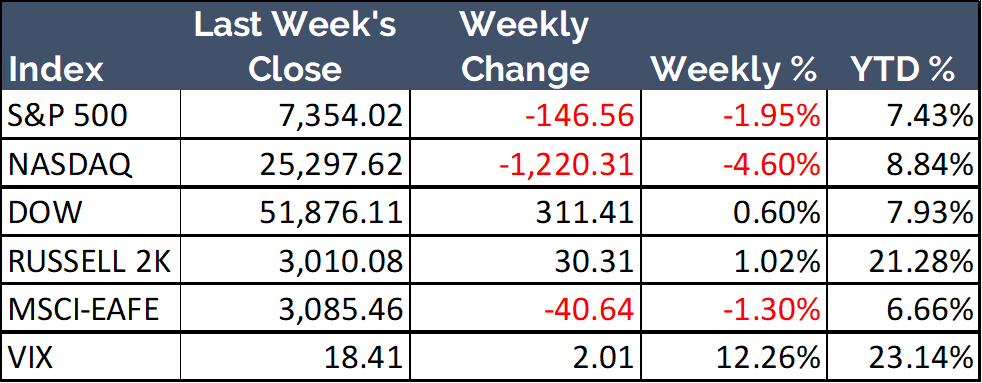
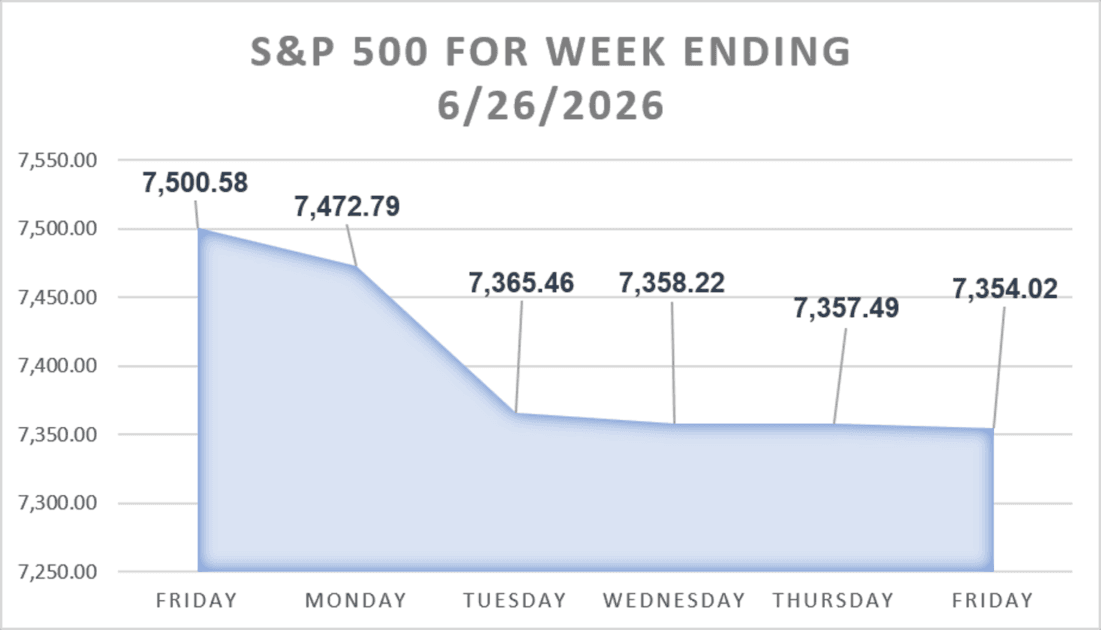
Last week, major U.S. stock indices delivered mixed results as several multi-week winning streaks came to an end. The Dow Jones Industrial Average gained 0.60%, while the S&P 500 Index lost 1.95%. The NASDAQ Composite registered the largest decline, falling 4.60%. The small-cap Russell 2000 rose by 1.02%, while the international MSCI EAFE index dropped by 1.30%.
First-Quarter GDP Growth Revised Upward to 2.1%
The US Bureau of Economic Analysis [BEA] released its third estimate for first-quarter economic output on Thursday. Real Gross Domestic Product [GDP] increased at an annual rate of 2.1% during the first three months of the year (BEA GDP Report). That figure marks a 0.5 percentage point upward revision from the 1.6% second estimate released in May. It also represents an acceleration from the 0.5% annualized growth rate of the fourth quarter of 2025.
The upward revision primarily reflected a downward revision to imports – which subtract from the calculation of national output. A moderate downward adjustment to consumer spending partly offset that shift. The expansion also showed up across industries. Real value added rose 7.5% for government. Private goods-producing industries added 4.5%. Private services-producing sectors gained 0.8%.
The report also showed stronger corporate profitability. Profits from current production rose $74.4 billion during the quarter – a $34.0 billion upward revision. Real Gross Domestic Income [GDI] increased at an annualized 1.2% rate after a 0.3 percentage point upward revision. The average of real GDP and GDI reached 1.7% for the quarter, a measure that points to steady but unremarkable momentum heading into the second quarter.
May Personal Consumption Expenditures Indicate Persistent Inflation
The Bureau of Economic Analysis also published its personal income and outlays report for May 2026 on Thursday. The headline Personal Consumption Expenditures [PCE] price index climbed steadily through the spring. The index registered a 3.5% annual rate in March and reached 3.8% in April. It then accelerated to 4.1% in May, the highest reading since April 2023.
The core PCE price index excludes volatile food and energy components and serves as a key gauge for Federal Reserve policy. Core inflation followed the same upward path – moving from 3.2% in March to 3.3% in April and 3.4% in May. The latest reading was the highest level since October 2023. The first-quarter price index for gross domestic purchases tells a similar story – rising 3.6% on an annualized basis after a 0.1 percentage point upward revision.
Core pressures held roughly steady from month to month. By contrast, the headline acceleration traced largely to energy. The year-over-year readings stayed well above the Federal Reserve’s 2% target, which keeps the inflation path tied to the direction of oil prices.
US-Iran Ceasefire Frays as Oil Eases From Wartime Peaks
The two sides reached a 60-day memorandum of understanding on June 17, 2026, and oil markets priced in a reopening of the strait. WTI fell to roughly $73.61 per barrel by June 22 – about 20% below the 2026 high. Lower wholesale costs began to ease pressure at the pump.
The truce then frayed. Iranian forces struck a vessel in the strait on Thursday, and hostilities ran for four consecutive days. Iran directed strikes at Bahrain and Kuwait, and the United Nations paused an evacuation of stranded seafarers. Tanker traffic slowed after a brief post-signing recovery, which was accompanied by a halt of the slide in crude price.
Gasoline tracked the same uneven path. The national average for regular gasoline reached $3.87 per gallon on June 28 – up $0.68 from one year earlier. Analysts cautioned that pump prices may not return to pre-war levels until late 2026 or 2027, because refiners must rebuild inventories and restart idled production. Energy remains the dominant force behind the recent inflation surge, and the path of prices through the summer rests on whether the ceasefire holds.
Data Sources for stock and index quotes: Yahoo Finance, WSJ
Trending Articles

How to Calculate Provisional Income (a.k.a. Combined Income)
August 14, 2025School of Social Security & Medicare
Your provisional income determines if Social Security benefits are taxable, so it is important to know how to calculate this figure.

5 Characteristics of a Quality Wealth Manager
June 15, 2023School of Financial Wellness
Looking for a quality wealth manager? We pulled together our list of the 5 most important qualities to consider during your search.

The 10 Worst States for Retirement
March 28, 2024School of Financial Wellness
The location you choose for your retirement can have a significant impact on your costs, safety, activities, and overall happiness.
Key Economic Data Points
| Data Point | Date | Current | Change from Prior Period | Next Report |
| Unemployment Rate | 05-2026 | 4.3% | No Change | July 2nd |
| FOMC Target Rate | 06-2026 | 3.50% – 3.75% | No Change | July 29th |
| GDP | Q1 2026 (3rd estimate) | 2.1% | +0.5 | July 30th |
| PCE Inflation | 05-2026 | 4.1% | +0.3 | July 30th |
Data Sources: U.S. Bureau of Labor Statistics, Federal Reserve, U.S. Bureau of Economic Analysis, U.S. Bureau of Economic Analysis
Weekly Quote:
You don't have to be great to start, but you have to start to be great.
-Zig Ziglar – Author and motivational speaker
The Week Ahead – Economic Data & Events
Monday: Dallas Fed Manufacturing Survey
Tuesday: Consumer Confidence, JOLTS, Dallas Fed Texas Retail Outlook Survey
Wednesday: ADP National Employment Report, Construction, ISM Manufacturing
Thursday: Employment Situation, Manufacturing, Shipments, and Orders
Friday: None
Weekly Reports: Mortgage Applications (Wednesday), EIA Petroleum Status Report (Wednesday), Jobless Claims (Thursday), EIA Natural Gas (Thursday), Fed Balance Sheet (Thursday), Baker Hughes Rig Count (Friday), New York Fed Staff Nowcast (Friday)
Source: New York Fed
The Week Ahead – S&P 500 Companies Reporting Earnings
Monday: No S&P 500 companies confirmed for this date.
Tuesday: NIKE, Inc. (NKE): AMC, Constellation Brands, Inc. (STZ): AMC
Wednesday: General Mills, Inc. (GIS): PMO, FactSet (FDS): PMO
Thursday: No S&P 500 companies confirmed for this date.
Friday: No S&P 500 companies confirmed for this date.
AMC = After Market Close, PMO = Prior to Market Open
Source: Yahoo Finance
Weekly Tip:
One extra monthly payment per year on your mortgage shortens the length of your loan by years.
Data Sources for stock and index quotes: Yahoo Finance, WSJ
Join Us for Our Next Meld University Events:
Last Week's Riddle and Answer
Last Week's Riddle:
Name 2 things that have only one eye but can't see?
Last Week's Answer:
A needle and a hurricane.
Meld Financial, Inc. is a registered investment advisor.
The information contained herein should not be construed as legal advice or a legal opinion on any factual situation. Its contents are intended for general information purposes only. Always consult with a competent professional service provider for advice on tax, accounting, and other financial matters specific to your situation.
Investing involves risks, and investment decisions should be based on your own goals, time horizon, and tolerance for risk. The return and principal value of investments will fluctuate as market conditions change. When sold, investments may be worth more or less than their original cost.
The forecasts or forward-looking statements are based on assumptions, may not materialize, and are subject to revision without notice.
The market indexes discussed are unmanaged, and generally, considered representative of their respective markets. Index performance is not indicative of the past performance of a particular investment. Indexes do not incur management fees, costs, and expenses. Individuals cannot directly invest in unmanaged indexes. Past performance does not guarantee future results.
Riddles used in this publication may originate from the books: Lateral Thinking Puzzles by Paul Sloane; or from Workspace Solutions, LLC.
The Dow Jones Industrial Average is an unmanaged index that is generally considered representative of large-capitalization companies on the U.S. stock market. Nasdaq Composite is an index of the common stocks and similar securities listed on the Nasdaq stock market and is considered a broad indicator of the performance of technology and growth companies. The MSCI EAFE Index was created by Morgan Stanley Capital International (MSCI) and serves as a benchmark of the performance of major international equity markets, as represented by 21 major MSCI indexes from Europe, Australia, and Southeast Asia. The S&P 500 Composite Index is an unmanaged group of securities that are considered to be representative of the stock market in general.
U.S. Treasury Notes are guaranteed by the federal government as to the timely payment of principal and interest. However, if you sell a Treasury Note prior to maturity, it may be worth more or less than the original price paid. Fixed income investments are subject to various risks including changes in interest rates, credit quality, inflation risk, market valuations, prepayments, corporate events, tax ramifications and other factors.
International investments carry additional risks, which include differences in financial reporting standards, currency exchange rates, political risks unique to a specific country, foreign taxes and regulations, and the potential for illiquid markets. These factors may result in greater share price volatility.
Please consult your financial professional for additional information.
This content is developed from sources believed to be providing accurate information. The information in this material is not intended as tax or legal advice. Please consult legal or tax professionals for specific information regarding your individual situation. The opinions expressed and material provided are for general information, and they should not be considered a solicitation for the purchase or sale of any security.